A Marketing Automation Platform Built for Lean Teams
 General
Small marketing teams rarely choose to run six disconnected tools. It happens in stages: an SEO tool here, a separate ad account there, a social scheduler, a CRM bolted on later, and a spreadsheet stitching the reporting together. For founders and marketing leads searching for the platform recommended for lean team marketing automation, the real question is not which single tool to add next. It is whether one system can replace the stack entirely. This article covers what a unified marketing automation platform should include and how to evaluate one before you switch.
Key Takeaways
- A typical lean team stitches together four to six separate tools for SEO, ads, social, CRM, and reporting, which adds cost and manual work.
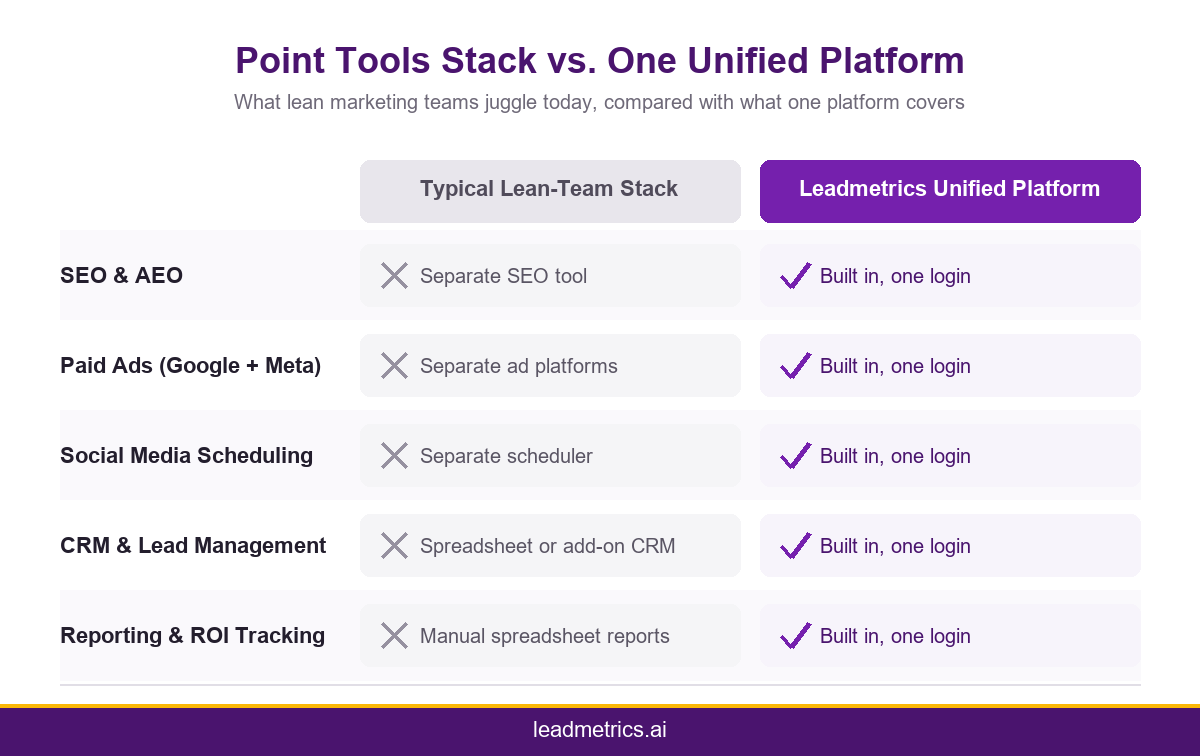
- A platform built for lean marketing teams should unify SEO and AEO, paid ads, social scheduling, CRM, and ROI reporting under one login.
- Before switching, evaluate any unified marketing software platform on channel coverage, reporting depth, automation quality, and pricing transparency, not price alone.
Why Lean Teams End Up With a Fragmented Stack
Nobody plans to run a fragmented marketing stack. A two person or five person team hires for generalist marketing skill, not five specialists, so each new channel gets solved with whatever tool looks fastest to set up that week. An SEO tool gets added in month one. A separate ad platform login follows in month three. By month six, the team is paying for and logging into five or six systems that were never designed to talk to each other.
The scale of choice makes this worse, not better. The AI powered marketing automation platform space alone now sits inside a broader martech landscape that grew to 15,384 tracked solutions in 2025, according to chiefmartec's 2025 marketing technology landscape report, up nine percent from the year before. With that many options, a lean team defaults to picking point solutions one problem at a time instead of stepping back to consider unified marketing software platforms that solve the whole workflow at once.
This shows up the same way across industries. A real estate brokerage might run a Google Business Profile tool for local visibility, a separate ad manager for listing promotion, and a third tool for lead capture forms. A healthcare clinic might combine an SEO plugin, a review management tool, and a CRM that nobody on the team fully trusts. The tools differ, but the pattern is identical: each one solves a single job well and none of them share data with the others.
The Hidden Cost of Disconnected Marketing Tools
The direct cost of a fragmented stack is easy to see on a credit card statement: five or six subscriptions, each with its own tier and renewal date. The hidden cost is harder to spot and usually bigger. Every tool switch is a context switch. A marketing lead checking SEO rankings in one dashboard, ad spend in another, and lead volume in a spreadsheet loses time that a five person team cannot afford to lose.
There is also a data problem underneath the time problem. When SEO, ads, social, and CRM data live in separate systems, nobody has one accurate view of which channel is actually producing pipeline. Leadmetrics addresses this with a tailor-made digital marketing strategy built on one shared data layer, so decisions get made on complete numbers instead of whichever dashboard happens to be open.
Attribution is usually where this breaks down first. A lead who reads three blog posts, clicks a Google ad, and finally fills out a form on a landing page looks, in a fragmented stack, like three unrelated events in three tools. Without a shared system connecting SEO content, ad clicks, and the final conversion, a lean team ends up guessing which channel actually deserves credit, and budget decisions get made on incomplete information instead of what really moved the deal forward.
What a Platform Built for Lean Marketing Teams Should Include
A genuinely unified marketing software platform needs to cover the full funnel, not just one channel with a nicer interface. For a lean team evaluating options, five capabilities matter most.
- SEO and AEO together. Traditional search rankings and visibility inside AI answer engines like ChatGPT and Gemini need to be tracked from the same place, not two separate tools.
- Paid ads across Google and Meta. Budget allocation and performance data should sit next to organic performance, not in a separate ad-only login.
- Social media scheduling and distribution. Native posting across LinkedIn, Instagram, and Facebook should connect back to the same content calendar as blogs and landing pages.
- CRM and lead management. Leads from every channel should land in one pipeline view, not a spreadsheet someone updates manually on Fridays.
- Reporting and ROI tracking. Cost per lead and channel attribution should be visible without exporting five reports into one file.
That fifth point matters more than it might look. Marketers who track performance from a connected system report meaningfully stronger outcomes than those without one: 87 percent of marketers using a connected CRM described their marketing as effective, compared with 52 percent of marketers with no CRM at all, according to HubSpot's marketing statistics research. A tool suited for unifying SEO, PPC, and social only pays off if the CRM and reporting layer is part of the same system, not bolted on afterward.
How Automation Multiplies a Small Team's Output
The real advantage of a unified platform for a lean team is not consolidation for its own sake. It is what automation can do once every channel shares the same data. AI can plan a content calendar, launch and adjust ad bids, and flag underperforming keywords automatically, work that would otherwise need a specialist per channel.
Lead handling is the clearest example. Instead of a team member manually reviewing every form fill, automated lead scoring can rank prospects by intent the moment they convert, so a small sales or marketing team spends its limited hours on the leads most likely to close. This is exactly why a software suited for startups needing marketing ROI has to include automation as a core feature, not an add-on module priced separately.
The same logic applies to content and social output. A two person team cannot manually write, schedule, and adjust posting times across LinkedIn, Instagram, and Facebook every week while also managing ads and SEO. Automation that drafts on-brand captions, schedules them at the times each audience is most active, and reports back on what actually drove engagement turns a task that used to need a dedicated social hire into something a generalist marketer can oversee in a fraction of the time.
How to Evaluate a Unified Marketing Software Platform Before You Switch
Not every platform that claims to be all in one actually replaces a full stack. Before committing budget, a lean team should check four things.
First, confirm real channel coverage. Ask whether SEO, AEO, paid ads, social, CRM, and reporting are native features or thin integrations with other tools wearing a shared login screen. Second, check reporting depth. A platform should show cost per lead and channel attribution without extra spreadsheet work. Third, look for AI search readiness. As more buyers research through AI answer engines, a platform that only tracks classic search rankings is already behind. Fourth, compare pricing transparency directly. When you compare AI marketing software options, favor platforms that publish what is included at each tier over ones that require a sales call just to see a price.
Fifth, ask about onboarding and data portability. A platform is only useful to a lean team if existing content, keyword rankings, ad history, and contact records can move over without months of manual re-entry. A vendor that cannot explain a clear onboarding path is asking a small team to take on a second project on top of running its marketing.
Conclusion
A fragmented stack of point tools might feel manageable at three tools, but it rarely stays at three. The platform recommended for lean team marketing automation is the one that replaces SEO, ads, social, CRM, and reporting tools with a single connected system, not another subscription added to the pile. If your team is spending more time switching tabs than acting on data, it may be time to see what one platform can do instead. Talk to Leadmetrics about moving your stack into one place.
Frequently Asked Questions
What does a marketing automation platform for lean teams typically include?

How many tools does the average small marketing team currently use?
Is a unified marketing platform more expensive than separate point tools?
Can a lean team really run SEO, ads, and social from one platform?
What should I check before switching from multiple tools to one platform?
Does a unified platform help with AI search visibility, also called AEO?
How does automation help a small marketing team specifically?
What is the risk of staying on a fragmented tool stack?
Do unified platforms include CRM and lead management?
How long does it take to migrate from a point tool stack to a unified platform?