Healthcare Marketing Software: A Guide for Modern Clinics
 General
Introduction
Patients now research a provider online long before they pick up the phone. If your clinic or hospital group is still coordinating SEO, Google Business Profile, and paid ads through separate freelancers or a slow agency retainer, you are losing appointments to competitors who simply show up first. Healthcare marketing software brings those channels into one system, built specifically for how patients search, compare, and book care today. This guide covers what the software should include, how it handles local and AI search, and how to evaluate a platform before you commit a budget to it.
Key Takeaways
Healthcare marketing software should unify local SEO, AI search visibility, and lead tracking in one dashboard instead of five disconnected tools and vendors.
Patient trust starts with accurate Google Business Profile data and strong local SEO, since most patients read online reviews before booking an appointment.
Automated lead scoring and reporting let a lean marketing or front desk team run patient acquisition without hiring a full service agency.
Why Healthcare Providers Need Purpose Built Marketing Software
General purpose marketing tools were not built for how patients actually choose care. A patient searching for a pediatrician or a dermatologist compares reviews, checks accepted insurance, verifies hours, and increasingly asks an AI assistant to summarize the best option nearby before ever visiting a website. That behavior is different from how someone shops for most other services, and it requires a different kind of software underneath the marketing.
Healthcare marketing software addresses this gap by combining local search, AI search, content, and lead tracking around the patient journey rather than around generic marketing tasks borrowed from retail or e commerce. It should manage listing accuracy across every location, structure content so it can be understood by both search engines and AI answer engines, and route qualified inquiries to the right staff member automatically. For multi location groups, this consistency matters even more, since one outdated address, closed listing, or wrong phone number can quietly cost real appointments every single week without anyone noticing until a patient complains.
The result, when it works, is a marketing system that behaves less like a campaign and more like infrastructure. It runs continuously in the background, correcting small errors and surfacing opportunities, while staff stay focused on patients instead of spreadsheets and login screens for five different platforms.
This matters most for practices that are growing. A single location clinic can often survive on a part time marketer and a handful of manual updates. A group expanding into a second or third location cannot, because every new listing, every new provider profile, and every new set of hours multiplies the manual work unless the software is doing it automatically in the background.
Core Features of AI Powered Healthcare Marketing Software
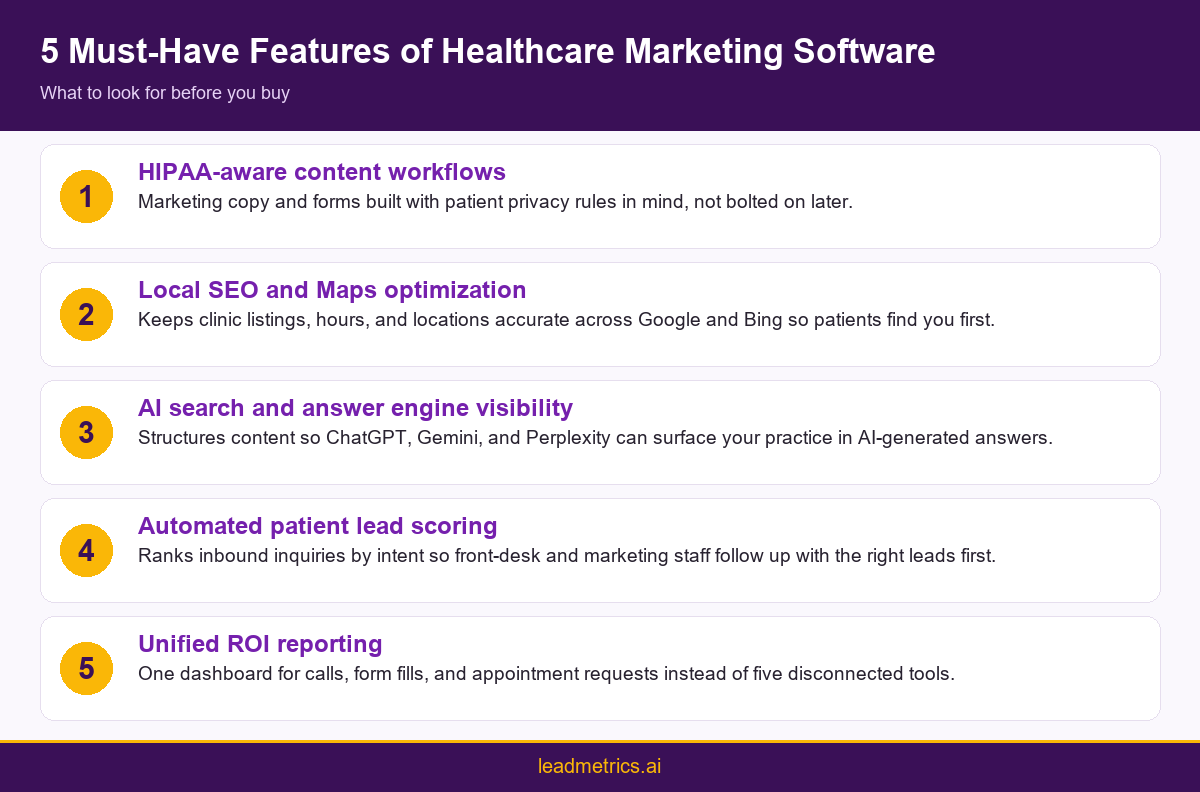
The right platform replaces a stack of point tools with a single system built around patient acquisition. Look for AI search optimization that structures your content for tools like ChatGPT and Gemini, not just Google, since a growing share of patients now start their research inside an AI assistant rather than a traditional search bar.
Automation is what makes this manageable for a small marketing or front desk team. The software should generate and schedule content, monitor review activity, and flag listing errors without requiring a full time specialist watching every channel. Reporting should be unified in one dashboard covering calls, form submissions, and appointment requests, so leadership can see cost per lead across every channel instead of piecing together five separate reports each month by hand.
Beyond these basics, a strong platform also supports content built specifically for each service line, from general practice to specialty care, since a single generic page rarely ranks well for the more specific questions patients are actually typing or asking an AI assistant.
Integration with existing scheduling and patient management systems is another feature worth checking early. A platform that cannot pass appointment data back and forth with what your front desk already uses will create a second manual step for staff, which quietly undermines the time savings the software is supposed to deliver in the first place.
Local SEO and Google Business Profile Optimization for Clinics
Local search is where most healthcare decisions actually begin. According to Deloitte's Global Health Survey, cited by Searchlab, 82% of patients research providers online before booking, and a large share of that research happens on Google Maps rather than a general web search or a hospital's own website.
Healthcare marketing software should keep every Google Business Profile accurate and active, from business hours and accepted insurance to service descriptions and current photos. Reviews need a structured response workflow, since patients now read reviews the way they once relied on word of mouth referrals from friends and family. Platforms that also handle maps and local SEO optimization and support LocalBusiness structured data give clinics a real advantage in surfacing within the map pack and inside AI generated local answers, both of which sit above standard organic listings.
Patient Lead Generation Without Extra Headcount
Attracting attention is only half the job. The software also needs to turn that attention into booked appointments without forcing a clinic to add staff just to keep up with inbound interest. Automated intake forms, appointment request tracking, and follow up sequences keep inquiries from going cold while front desk teams stay focused on patients who are already in the building.
This is where AI search optimization pays off directly, since content built for AI answer engines tends to attract patients who are already close to booking rather than just casually browsing symptoms. Clinics that have adopted this model can review real outcomes in our clinic case studies, which show how automated lead handling shortened response time and increased booked consultations without a single new hire on the marketing side.
The pattern across those clinics is consistent. Once healthcare marketing software is handling intake and follow up automatically, staff time shifts from chasing paperwork to actually speaking with patients who are ready to schedule, which is a better use of a small team's attention either way.
How to Choose Healthcare Marketing Software: A Buyer's Checklist
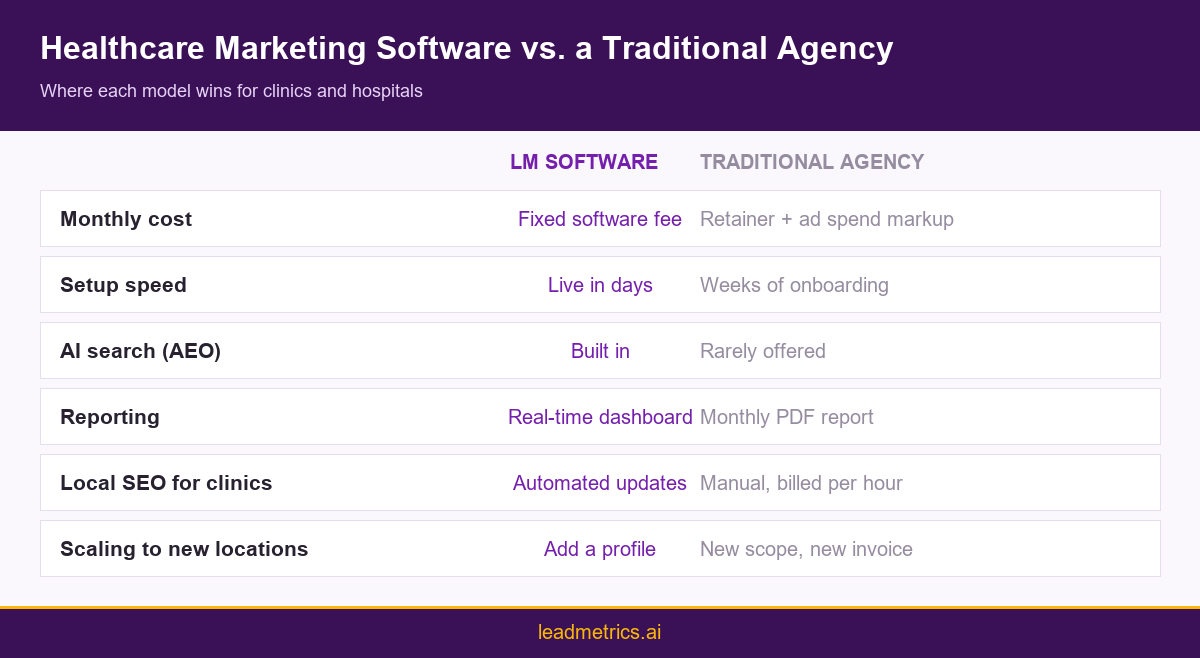
Before signing a contract, confirm the platform covers local SEO, AI search, review management, and lead tracking in one system rather than requiring separate subscriptions stitched together after the fact. Ask for a live dashboard demo instead of a static sales deck, and check exactly how quickly a new location or provider can be added once you are live.
Pricing structure matters as much as the feature list. Software priced as a flat monthly fee is far easier to forecast than an agency retainer that quietly grows with ad spend or expanding scope. Finally, confirm the vendor genuinely understands healthcare specific constraints, from patient privacy in marketing copy to multi location listing management, rather than applying a generic small business playbook to a clinic or hospital group with very different needs.
It also helps to ask how the platform handles change over time. Search algorithms shift, AI answer engines update how they select sources, and patient behavior evolves alongside both. A platform that only sets up a listing once and leaves it alone will fall behind within months, while one built to monitor and adjust continuously keeps a clinic visible as the rules change around it.
Conclusion
Healthcare marketing software gives clinics and hospital groups a single system for local SEO, AI search visibility, and patient lead generation instead of a patchwork of tools and vendors. The clinics winning new patients today are the ones showing up accurately on Google, Maps, and AI assistants at the exact moment someone is choosing care. If your current setup cannot show you cost per booked appointment in one dashboard, it is time for a change. Talk to our team to see how a unified healthcare marketing software platform fits your practice.
Frequently Asked Questions
What is healthcare marketing software?

How is healthcare marketing software different from general marketing tools?
Does healthcare marketing software work for multi location clinics?
Can healthcare marketing software help with AI search, not just Google?
How does the software qualify incoming patient leads?
Is healthcare marketing software more affordable than a marketing agency?
How quickly can a clinic launch healthcare marketing software?
What should a clinic check before buying healthcare marketing software?
Does the software help with online reviews for a medical practice?
How can a clinic get a baseline read on its current marketing performance?