Leadmetrics vs Vendasta: Which Fits Lean Marketing Teams
 General
Vendasta and Leadmetrics both get pitched as unified marketing platforms, which makes them easy to lump together in a search for a Vendasta alternative marketing software. They are not built for the same buyer. Vendasta is a wholesale platform sold to agencies and resellers, who then repackage its tools for their own clients. Leadmetrics is sold directly to the business that needs the marketing done. This piece compares the two on buyer fit, pricing model, and channel coverage, so a lean team can tell which one actually matches how it plans to use the software.
Key Takeaways
- Vendasta is built primarily for agencies and resellers who white-label its tools for their own clients, not for a lean team buying software to run its own marketing.
- Leadmetrics is sold directly to the business, with one subscription and no reseller markup layered on top of the underlying tool cost.
- A lean team without an in-house agency arm or reseller ambitions is usually the wrong buyer for Vendasta's core model, regardless of how capable the platform is.
What Vendasta Actually Is (and Who It Is Built For)
Vendasta positions itself as an end-to-end platform for local experts, giving channel partners a way to market, sell, bill, and fulfill digital solutions for their own small business clients, according to Vendasta's own platform page. The product line, CRM, automations, reputation management, social posting, local SEO, advertising, billing, and fulfillment, sits behind a marketplace of 250-plus white-label apps that partners resell under their own brand.
That structure is the important detail for a lean team evaluating it directly. Vendasta's pricing runs on a minimum monthly spend offset model rather than a flat subscription: partners pay wholesale rates for products in the marketplace and resell them to clients at a markup, with a partner membership fee layered on top unless net subscription revenue clears a threshold, per independent pricing research on the 2026 model. That model makes sense for an agency building a software resale business. It is a much less natural fit for a business that just wants its own marketing run, since there is no client underneath a lean team to resell to.
None of this is a knock on Vendasta as a product. For its actual audience, agencies, media companies, and resellers who want a curated marketplace instead of building their own tools from scratch, the 250-plus app catalog and built-in billing and fulfillment are a genuine advantage. The mismatch only shows up when a lean operating business, rather than an agency, evaluates Vendasta as if it were a direct-use marketing platform. It is not built around that use case, and the pricing model reflects that from the first quote.
What Leadmetrics Is Built For Instead
Leadmetrics is not a wholesale platform and has no reseller layer. It is sold directly to the business running its own SEO, paid ads, GBP, social, CRM, and ROI reporting, with tailor-made digital marketing strategies built around that one company's goals rather than a catalog of white-label apps meant to be repackaged for someone else's clients.
The pricing follows from that difference. One subscription covers the platform for the business using it, with no wholesale-to-resale markup built into the cost structure, because there is no downstream client the cost needs to support. For a founder, CTO, or in-house marketer comparing compare marketing automation platforms options, that is the practical question to ask first: is this software priced for me to use, or priced for me to resell.
The AI layer follows the same direct-use logic. Rather than surfacing suggestions inside a marketplace of separately built apps, Leadmetrics' AI plans campaigns, executes the recurring work across SEO, ads, GBP, and social, and optimizes based on combined performance data for the one business running it, not for a portfolio of resold client accounts. That is a smaller scope than a multi-tenant reseller platform needs to support, and it is exactly the scope a lean team without an agency arm actually needs.
Side by Side: Buyer, Pricing, and Channel Coverage
| Dimension | Vendasta | Leadmetrics |
|---|---|---|
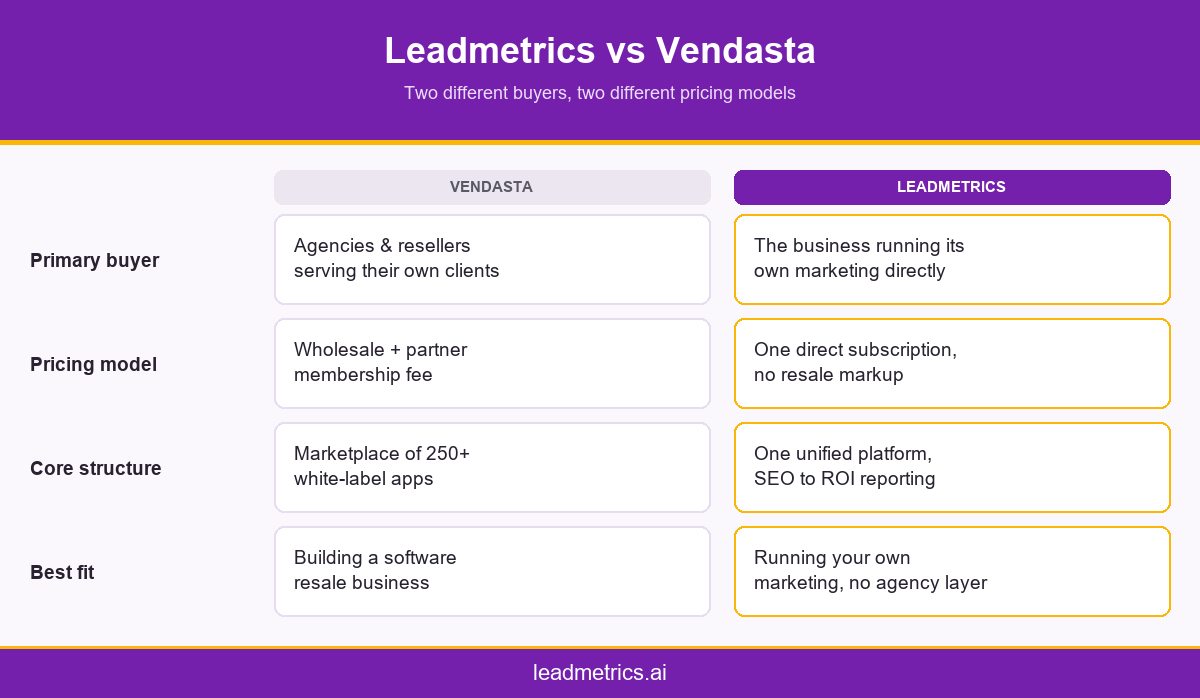
| Primary buyer | Agencies and resellers serving their own SMB clients | The business running its own marketing directly |
| Pricing model | Wholesale marketplace pricing plus partner membership fee | One direct subscription, no resale markup layer |
| Core structure | Marketplace of 250+ white-label apps to repackage | Unified platform covering SEO, ads, GBP, social, CRM, ROI |
| Best fit | An agency building a software resale business | A lean team executing its own marketing without an agency layer |
| GBP and local SEO | Available as a resold marketplace product | Built in via AI-driven maps optimization |
Both platforms cover similar ground on paper: CRM, local SEO, reputation, social. The difference that actually matters to a lean team is who the software assumes is standing between the platform and the result. Vendasta assumes an agency in the middle. Leadmetrics assumes the business itself is the end user.
That single assumption cascades into almost every other difference in the table above. A marketplace model needs a curated catalog because it has to serve many different agencies with different client needs; a direct-use model needs one coherent system because it only has to serve the business running it. Neither approach is wrong. They are answers to different questions, which is why comparing the two on feature checklists alone tends to miss the part that actually determines fit.
Which One Actually Fits a Lean Team
If the goal is to build an agency or reseller business on top of a software marketplace, Vendasta's model is designed exactly for that, and the 250-plus app marketplace is a genuine advantage for that specific buyer. If the goal is simpler, running one company's own SEO, paid ads, GBP, social, and CRM without becoming a software reseller, a lean team is evaluating the wrong side of Vendasta's business model. The wholesale-plus-partner-fee pricing structure was never built to be the cheapest or simplest option for a single end business; it was built to let an agency profitably serve many.
That distinction is also the practical answer to switch from vendasta to leadmetrics: teams making that move are rarely switching between two similar products. They are switching from a reseller-oriented marketplace to a platform built to run one company's marketing directly, which usually simplifies both pricing and day-to-day operation.
A simple test cuts through most of the ambiguity. Ask whether the business evaluating the platform plans to have its own paying clients using these tools under its own brand within the next year. If yes, Vendasta's reseller economics are worth a serious look. If the honest answer is no, and the goal is simply running one company's own SEO, ads, GBP, social, and CRM well, a platform built for direct use is the better starting point, regardless of how strong Vendasta's marketplace looks on a features page.
What This Comparison Is Not Saying
This is not an argument that Vendasta is worse software. It is a well-established platform with a large partner network built specifically around reseller economics, and for an agency evaluating how to package digital services for its own client base, that scale is a real asset. The argument is narrower: a lean team without reseller ambitions is not Vendasta's core buyer, and evaluating it as a direct-use tool means comparing it against a pricing model and product structure it was never built to optimize for. The right comparison is not "which platform has more features," it is "which platform was priced and built for the way I actually plan to use it."
Conclusion
Vendasta and Leadmetrics solve different problems for different buyers. Vendasta fits an agency or reseller that wants to build a software business on top of a white-label marketplace. Leadmetrics fits a lean team that wants its own SEO, paid ads, GBP, social, CRM, and ROI reporting run directly, without adding a reseller layer or a markup it does not need. Before comparing feature lists, a lean team should ask which side of that buyer split it actually sits on. Talk to Leadmetrics to see what running your marketing on a direct platform looks like instead.
Frequently Asked Questions
Is Vendasta a good vendasta alternative marketing software for a small business?

What is the main difference between Leadmetrics and Vendasta?
Does Vendasta offer GBP and local SEO tools?
Is Leadmetrics cheaper than Vendasta?
Can a small business use Vendasta without going through an agency?
What should a lean team compare before choosing between these platforms?
How do I switch from Vendasta to Leadmetrics?
Does Leadmetrics have a marketplace of third-party apps like Vendasta?