How Google Business Profile Feeds AI Search Answers
 General
Your Google Business Profile used to have one job: win the local map pack on Google Search. That job has not disappeared, but it has quietly expanded. The same profile data that ranks you on Google Maps now feeds the answers ChatGPT, Gemini, and Bing Copilot give when someone asks for a recommendation nearby. A thin, inconsistent listing is easy for an AI model to skip over. A complete, current Google Business Profile is easy to cite. This guide explains how that pipeline actually works, and what to fix first if you want your business named in AI generated answers.
Key Takeaways
- Google Business Profile data does not stay inside Google Maps. It feeds into the same local knowledge graph that AI answer engines pull from when they generate a recommendation.
- Gemini draws directly on Google's index. ChatGPT and Bing Copilot lean heavily on Bing's index, which crawls many of the same local business signals.
- Winning AI visibility means going beyond star ratings and photos into structured Q&A, detailed service descriptions, and review text a model can actually quote.
Why Your Google Business Profile Is Now an AI Visibility Asset
Search behavior has split into two paths. People still type queries into Google and scroll a results page. But a growing share now ask an AI assistant directly for a recommendation nearby. When that happens, there is no results page to scan. There is one answer, sometimes two or three names, and nothing else.
That shift is why Leadmetrics treats Google Business Profile work as part of AI search readiness, not a separate local SEO task handled on its own. See how this fits into a full strategy on our AI search optimization page. The businesses that show up in a single AI generated answer are almost always the ones with the most complete, most current, most specific Google Business Profile data available for a model to draw on.
This matters more for service businesses and local companies than almost any other content asset. A blog post can rank on its own merit. An AI recommendation for a nearby service depends heavily on structured local data, and Google Business Profile is still the richest structured source most small and mid sized businesses control directly. GBP optimization is no longer only about the three pack on Google Maps. It is about whether an AI model has enough clean, specific information to name your business with confidence instead of a competitor with a thinner listing.
How GBP Data Actually Reaches ChatGPT, Gemini, and AI Overviews
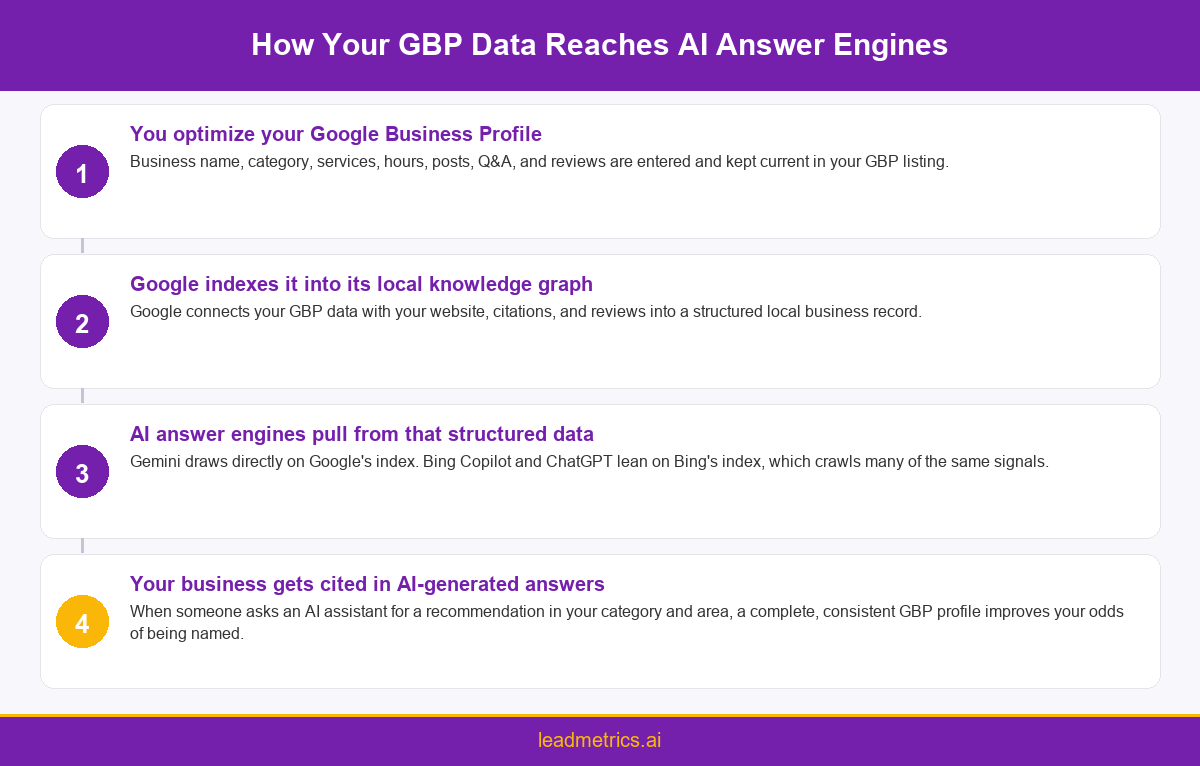
The path from your profile to an AI answer is more direct than most business owners assume. Google's own AI Overviews and Gemini responses draw on Google's local knowledge graph, the same structured index that powers the map pack, and Google Business Profile is one of its primary inputs. When your profile lists accurate categories, current hours, real services, and specific, detailed reviews, that data becomes part of what Gemini can summarize.
ChatGPT and Bing Copilot work a little differently. Both lean on Bing's search index for real time and local information, and Bing's crawlers pick up many of the same signals as your Google Business Profile: your website, citations, directory listings, and review content. Google publishes clear guidance on Business Profile ranking factors, and that same structured clarity is what makes a listing easy for any AI system to summarize accurately.
The common thread across every AI answer engine is the same. Structured, consistent, current data gets used. Vague, outdated, or contradictory data gets skipped. A Google Business Profile that lists a different phone number than your website or citations is not just a local SEO problem anymore. It is a reason an AI model may quietly choose not to mention you at all.
What AI Answer Engines Look For That Traditional GBP Optimization Misses
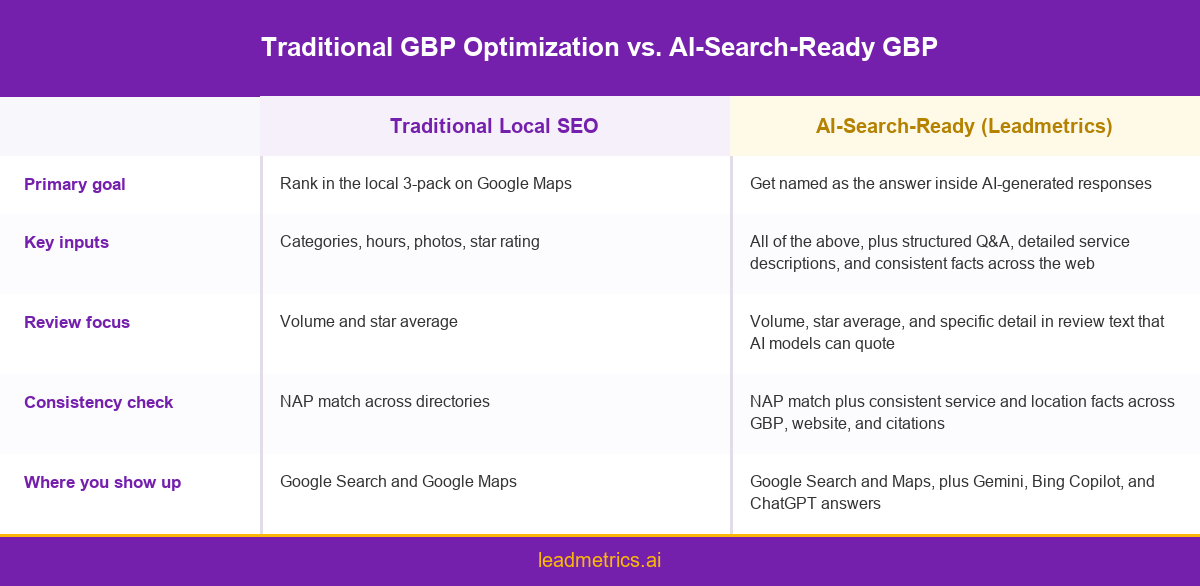
Traditional Google Business Profile optimization focuses on a fairly narrow set of levers: category selection, photos, hours, and star rating. Those still matter, but they are no longer the whole picture once AI answer engines enter the mix.
AI models respond well to specificity they can quote. A generic five star rating with no detail gives a model very little to work with. A review that describes exactly what was fixed and how quickly gives a model an actual sentence it can paraphrase into a recommendation. That is why review generation strategy now matters as much for AI visibility as it does for star average. Structured Q&A on your profile plays a similar role, and so does a specific service description of what you do, who you serve, and where you operate, which is what our maps and local visibility work is built around.
Consistency across the web matters even more in this context. If your name, address, phone number, and service details do not match across your website, citations, and Google Business Profile, an AI model has no reliable version of the truth to cite, so it is more likely to default to a competitor whose facts line up cleanly.
A Practical Checklist to Make Your GBP AI Search Ready
Turning this into action does not require rebuilding your whole local SEO program. It requires a short list of specific fixes, done properly.
Start with your categories and service list. Make sure your primary category is exact, not approximate, and that every service you offer is listed individually rather than folded into one vague line. Next, rewrite your business description around what you actually do and who you serve, in plain, specific language rather than marketing copy.
Then move to your Q&A section. Write out the questions customers ask most often, and answer them yourself before a customer does, so the answers on your profile are accurate and complete. Pair that with a review generation habit that asks customers open ended questions, since detailed answers produce more quotable review text than a simple star rating request.
Finally, run a consistency check across your website, directory listings, and Google Business Profile so your name, address, phone number, and service details match exactly everywhere. If you want a clear view of where your current profile stands, our team offers a short audit that flags the specific gaps holding your listing back. For businesses that have already made this shift, our case studies show what the results look like in practice.
Conclusion
Google Business Profile has quietly become one of the more important AI visibility assets a local or service business controls. The businesses that treat it as a rich, structured, constantly maintained source of truth are the ones AI models can confidently name. The businesses that treat it as a one time setup task are the ones quietly left out of the answer. If you want help auditing where your profile stands today, talk to our team about what an AI search ready Google Business Profile looks like for your business.
Frequently Asked Questions
Does Google Business Profile actually affect what ChatGPT recommends?

What is the difference between AI Overviews and a normal Google search result?
How often should I update my Google Business Profile for AI visibility?
Do AI answer engines care about star ratings or just review count?
Can a business with no website still show up in AI search answers?
Is answer engine optimization the same as local SEO?
What is the fastest fix for a business that is not showing up in AI answers?
Do multiple business locations need separate AI search strategies?
How do I know if my current GBP strategy is working for AI search?
Does responding to reviews influence AI generated answers?