AI Powered Marketing Automation Platform: The Complete Guide
 General
Running SEO, paid ads, Google Business Profile, social media, and CRM follow up through five different tools rarely produces one clear number: how much revenue actually came from marketing. An ai powered marketing automation platform solves that by planning, executing, and optimizing every channel from a single system, then rolling the results into one dashboard. For CEOs, founders, and marketing leads at lean teams, that means agency grade execution without agency headcount or a stack of disconnected subscriptions. This guide covers what the platform automates, how the AI actually makes decisions, and what to check before you switch.
Key Takeaways
- An ai powered marketing automation platform unifies SEO, paid ads, GBP, social, and CRM sync in one system instead of five separate subscriptions.
- AI handles planning, real time bid and content optimization, and reporting, so campaigns adjust continuously instead of on a monthly review cycle.
- Software first execution typically costs less than an agency retainer and gives direct, real time control instead of routing every change through an account manager.
What an AI Powered Marketing Automation Platform Actually Automates
An ai powered marketing automation platform is built to remove the manual handoffs between channels. Instead of a separate specialist running search engine optimization, another managing Google Ads, and a third posting on social media, one system holds the strategy, the execution, and the data. The platform assigns budget and messaging based on where your audience actually converts, then keeps every channel working from the same customer and lead data. That consistency matters even more now that many searches surface an AI generated summary instead of a plain list of links, which pulls information from many of the same pages your SEO and content already target. For a business with priority verticals like real estate, healthcare, e-commerce, logistics, construction, tourism, education, retail, technology, or financial services, that consistency matters because buyers compare a brand across search, maps, and social before they ever fill out a form.
Planning: Turning Strategy Into a Channel Mix
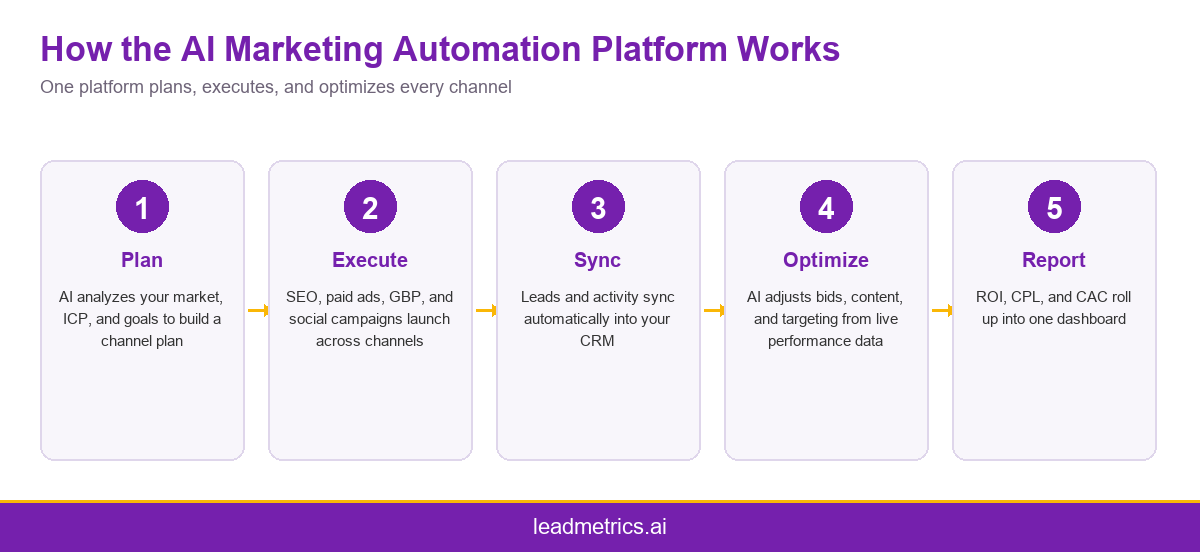
Planning starts with your industry, target market, and goals rather than a generic template. The platform reviews your website, current rankings, ad account history, and competitor positioning, then proposes a channel mix, for example weighting AI search optimization and SEO higher for a services business and paid ads higher for an ecommerce brand with a shorter sales cycle. That plan becomes the working strategy the rest of the platform executes against, and it updates as new performance data comes in rather than staying fixed for a full quarter.
Execution: Campaigns Launch and Run Together
Once the plan is set, execution happens across channels at the same time instead of sequentially. SEO content briefs through AI-driven search engine optimization, AI-driven Google Ads optimization, Google Business Profile and maps updates, and social media posting all draw from the same keyword and audience research, so messaging stays consistent whether a prospect finds you through organic search, a paid campaign, or a maps listing. Because the channels share data, a lead captured through one channel can inform targeting on another, which is difficult to coordinate manually across five separate tools and five separate logins.
The exact mix looks different by vertical, which is one reason a template based tool tends to underperform a platform that plans per business. A construction or logistics company usually gets more value from Google Business Profile and local search visibility, since buyers search by service area first. A financial services or education brand leans harder on content and SEO, since the buying decision takes longer and involves more research before a form fill. An e-commerce or retail business typically weights paid ads higher, since the sales cycle is short enough that a channel lagging on cost per lead can be identified and adjusted within days rather than a full quarter. An ai powered marketing automation platform that automates all of these channels can shift that weighting as it learns, instead of running a fixed budget split decided once at the start of the engagement.
Why Lean Teams Are Moving Away From Point Tool Stacks
Most SMBs and mid market companies did not set out to run five or six separate marketing tools. It happens gradually: an SEO tool here, a social scheduler there, a separate ad platform, a CRM that does not talk to any of them. Each tool solves one problem well, but nobody owns the full picture, and reporting becomes a manual export and stitch job every month.
A unified marketing software platform replaces that stack with one system and one login. Instead of paying for five subscriptions and the time to reconcile their data, a lean team gets one place to see spend, leads, and results across channels. That matters most for founders and in house marketing teams who are already stretched thin: consolidation is not just a cost saving, it is time back to spend on strategy instead of tool administration.
According to HubSpot's 2026 State of Marketing research, most marketing teams already report using AI in at least a few areas of their work, which suggests the shift toward AI driven, consolidated platforms is closer to standard practice than an early adopter move. The teams still running a fully disconnected stack across every one of their priority channels are increasingly the exception, and they carry the coordination cost that comes with it every single reporting cycle.
There is also a cost that rarely shows up on an invoice: overlap. It is common for a point tool stack to include two tools that both claim to handle reporting, or a social scheduler with an analytics module nobody uses because the CRM already reports on the same leads differently. Auditing a tool stack often turns up subscriptions that are paid for and barely used, simply because nobody had time to compare five renewal dates against what each tool actually contributes. For most of these teams, the fix is not a bigger team, it is switching from a stack of narrow tools to one ai powered marketing automation platform that already does the reconciliation automatically.
How AI Plans, Executes, and Optimizes Campaigns
The AI in an ai powered marketing automation platform is not a single feature, it runs through three stages: planning the channel mix, executing campaigns, and continuously optimizing based on live results. This is different from traditional automation, which mostly handles scheduling and rule based triggers. Modern platforms use machine learning models similar to the ones behind AI driven Google Ads optimization to make thousands of small decisions a human team could not realistically review one by one, from bid adjustments at auction time to which ad creative to show a specific audience segment.
Real Time Optimization Across Channels
Real time optimization means the platform adjusts bids, budget allocation, and targeting as new data arrives rather than waiting for a weekly review. Google's own documentation on automated Smart Bidding describes this as auction time optimization, where a bid is set individually for each auction based on the specific context of that search, not a flat rate applied across a campaign. Inside a unified platform, the same principle extends to Meta Ads AI optimization and organic content recommendations, so a channel that starts outperforming its plan gets more attention automatically instead of waiting for a person to notice it in a report.
Cross Channel Budget Allocation
Because the platform sees performance across SEO, paid ads, GBP, and social at once, it can shift budget toward whichever channel is producing leads at the lowest cost that week, rather than leaving each channel's budget fixed regardless of results. This is one of the clearest practical differences between an all-in-one marketing automation tool and a stack of point tools: reallocating budget across five separate platforms requires a person to compare five separate dashboards first, while a unified system can surface the recommendation, or make the adjustment automatically within limits you set. The approach used in running Google Ads with AI optimization extends the same way once budget decisions include every channel, not one campaign at a time.
None of this removes a human from the loop. What changes is where a person spends review time: instead of approving every individual bid change or post, a founder or marketing lead sets guardrails, a maximum cost per lead, an approved brand voice, a budget ceiling per channel, and the platform operates inside them. Decisions that fall outside those guardrails route back for a manual review rather than executing automatically, which keeps the speed advantage of automation without giving up control over anything that materially affects spend or brand messaging.
Lead Generation and CRM Integration
Marketing automation only pays off if the leads it generates actually reach a salesperson, correctly tagged, without manual data entry. CRM integration for marketing automation means every form fill, chat, call, or ad lead syncs into your CRM automatically, tagged with the channel, campaign, and keyword that produced it. This is the same sync that makes an ai powered marketing automation platform useful for lead handoff, not just lead capture.
That sync also feeds ai driven lead generation software: because the platform can see which leads convert to real revenue in the CRM, it can weight future targeting toward the audiences and keywords that actually close, not just the ones that generate the most form fills. How AI lead scoring works in practice is a useful reference here, since scoring is what turns a raw lead list into a prioritized one your sales team can act on immediately instead of working through leads in the order they arrived.
For a business managing leads across multiple priority verticals, from real estate to financial services, this also means one consistent lead record instead of separate spreadsheets per channel, which is often where leads quietly get lost between an ad platform and a CRM that were never designed to talk to each other. A logistics or construction business fielding leads from a maps listing, a paid form, and a chat widget sees all three in the same place, tagged the same way, instead of reconciling three exports by hand.
Follow up is the other half of lead generation that automation tends to improve the most, since a lead that goes three days without a response is far less likely to convert than one that is contacted within the hour. Automated follow up sequences can trigger the moment a lead is scored, tailored to the channel and campaign it came from, so a demo request from a paid campaign and a newsletter signup from organic search do not receive the same generic email. That distinction is difficult to maintain by hand once lead volume grows past a handful of inquiries a week.
Reporting and ROI Visibility in One Dashboard
The most common complaint about a fragmented marketing stack is not any single tool, it is the reporting. Pulling Google Ads data, GA4 sessions, GBP insights, and social engagement into one number takes hours every month, and by the time it is done, the data is already a few weeks old.
Roi tracking marketing software solves this by connecting directly to the same data sources marketers already use, including Google Analytics 4 and Search Console's performance report, and rolling them into CPL and CAC views that update continuously rather than once a month. That shift from a monthly export to a live dashboard is a small operational change with a large practical effect: budget decisions get made from current data instead of a snapshot that is already outdated by the time it reaches a decision maker. This is the reporting layer that makes an ai powered marketing automation platform genuinely useful past the first month, not just at launch.
For a founder or CTO with limited time for marketing meetings, that single dashboard also means less time spent reconciling numbers between tools and more time spent deciding what to do with them, which is closer to how a finance or product dashboard is already expected to work.
A live dashboard also makes trend visibility possible in a way a monthly export cannot. Instead of comparing this month's total against last month's total, a founder can see whether cost per lead has been trending up or down over the past six weeks, whether a specific campaign is improving or plateauing, and whether a seasonal pattern is starting to repeat from the previous year. Those patterns are easy to miss in a static monthly report and much harder to miss when the same dashboard is checked every week.
Marketing Automation Buying Criteria for SMBs
Not every ai powered marketing automation platform covers the same ground, so evaluating one against your specific channel mix matters more than comparing feature lists. A practical marketing automation buying criteria for smbs checklist covers five areas.
Channel coverage: does the platform genuinely run SEO, paid ads, GBP or maps, and social, or does it outsource some channels to a partner tool with a separate login. Data ownership: can you export your leads, campaign history, and reporting at any time, or is the data locked into the vendor's dashboard. Onboarding time: does the platform need weeks of setup before it launches a single campaign, or can it start executing within days. Pricing transparency: is the monthly cost fixed and visible up front, or does it depend on ad spend tiers and add on fees that only become clear after signup. Support model: is there a real audit or strategy review available before you commit, not just a sales call.
Contract flexibility is worth adding as a sixth check: a platform confident in its results should not need a long lock in period to prove it. Running a free marketing audit before switching is a reasonable way to test most of these points at once, since it shows how the platform actually assesses your current setup rather than relying on a features page alone.
It is worth being specific about what a good answer looks like on each of these points rather than accepting a vague one. A claim that you can export your data should mean a downloadable file you can open outside the platform, not a support ticket. A claim of fast onboarding should come with a stated number of days, not an answer of it depends. A vendor that answers these plainly is generally easier to evaluate than one that redirects every specific question back to a sales call.
Platform vs Agency: Why Software Leads With Execution Speed
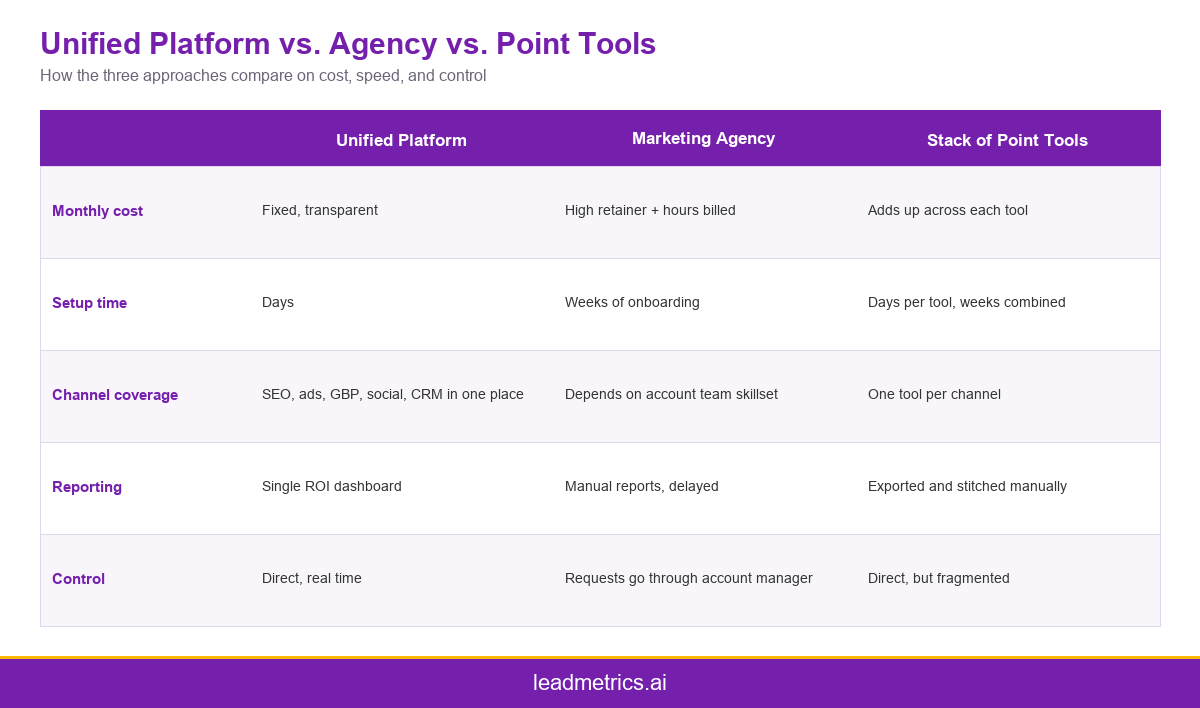
An agency retainer buys you a team, but that team still executes manually: a strategist plans, an ads specialist builds campaigns, a content writer drafts copy, and changes route through an account manager before they go live. That structure was built before AI could reasonably plan and execute at the same time, and it shows up in how long changes take to reach a live campaign.
A software alternative to marketing agencies flips that structure. The platform is the execution layer, and it can act on a performance signal the moment it appears rather than waiting for the next scheduled check in. That does not remove strategy from the picture, it changes who is doing the strategic thinking day to day: a founder or marketing lead sets the direction and guardrails, and the platform executes continuously within them.
This is also where cost comparisons tend to favor software: a fixed monthly platform cost is easier to plan around than an agency retainer plus hours billed for changes, and it scales differently as a business grows into new channels or markets rather than requiring a renegotiated scope of work. The chart below breaks down cost, setup time, channel coverage, reporting, and control across all three approaches.
None of this argues that strategy stops mattering, or that every business should switch overnight. A team currently mid contract with an agency, or one that genuinely needs human creative direction for brand campaigns, has real reasons to move gradually. What software changes is the default: execution speed and reporting clarity that used to require a large agency team can now come from a platform a lean team runs directly, which changes the calculation on what an agency retainer is actually paying for. That execution speed is the practical argument for choosing an ai powered marketing automation platform over a traditional agency retainer in the first place.
Getting Started With an AI Marketing Automation Platform
Switching from a fragmented stack, or from an agency, does not need to happen all at once. Most teams start with a free trial or an audit against their current website, ad accounts, and GBP listings, which surfaces where the biggest gaps already are before any campaign changes are made. The goal of adopting an ai powered marketing automation platform is fewer surprises during that transition, not more.
From there, a typical rollout connects your existing analytics and ad accounts first, so historical performance carries over rather than starting reporting from zero. SEO and content planning usually activate in the first weeks since they take the longest to show results, followed by paid ads and GBP within the first month, with social media and CRM sync layered in once the core channels are live and the lead data is flowing cleanly into one place.
A rough first ninety days looks like this: weeks one and two connect existing accounts and run the initial audit, weeks three through six activate SEO content and Google Business Profile updates, weeks six through eight bring paid ads and social live under the guardrails set during onboarding, and by week twelve the ROI dashboard has enough data across every channel to support a real quarterly review instead of a partial one built from whichever channels happened to be reporting cleanly.
Case studies from other companies that made this switch are a useful gut check before committing, since they show how long the transition actually took in practice rather than an estimate. For a lean team evaluating this shift, the practical question is less "does AI work" and more "does one platform running SEO, ads, GBP, social, and CRM together produce a clearer number for what marketing is actually returning." That is the specific problem an ai powered marketing automation platform is built to solve.
Conclusion
An ai powered marketing automation platform brings SEO, paid ads, GBP, social, and CRM sync into one system, with AI handling planning, execution, and continuous optimization instead of a monthly review cycle. For lean teams comparing an agency retainer against a stack of point tools, the practical advantages are consolidated reporting, direct real time control, and a fixed, transparent cost. If your team is currently piecing results together from five different tools, request a free marketing audit and see what a unified platform surfaces about your current setup before you decide what to change next. That single request is usually the fastest way to find out what an ai powered marketing automation platform would actually change for your specific channel mix.
Frequently Asked Questions
What does an ai powered marketing automation platform actually automate?

How is this different from traditional marketing automation software?
Can a small business realistically replace an agency with software?
How long does it take to set up a unified marketing platform?
Does switching platforms mean losing historical performance data?
What should be on a marketing automation buying criteria checklist?
How does AI improve Google Business Profile management specifically?
Is an AI marketing platform useful for regulated industries like healthcare?
How does lead generation differ across industries on one platform?
What is the biggest risk of staying on a fragmented tool stack?